Direct booking
Booking.com commission:what it really costs your holiday rental each year
Fifteen percent sounds like very little, until you add it up for a whole year. Here is how Booking.com and Airbnb work out their fees, what that comes to for a typical holiday rental, and what helps more guests book direct with you.

Carlos Ortiz Liz
· 8 min read
I have worked in tourism for 13 years, and together with Zita I run casa abruzzo, our cooking trips in Abruzzo. Our guests book through a booking module on our own website. When I talk to other hosts, the same question comes up sooner or later: is that worth the effort, or is it better to run everything through Booking.com?
An honest answer starts with a number that many people don't know exactly: what the portals actually cost you over a year. So let's work it out properly.
Direct on your website
Booking.com at 15%
Booking.com with programmes, e.g. 18%
Airbnb, host-only fee, 15.5%
An example. Payment fees and VAT on the commission are not included.
How Booking.com calculates its commission
With Booking.com you pay a fixed percentage of the reservation value on every booking. Listing your property costs nothing. How high the rate is depends on the country, the type of property and the location. Booking.com says so itself in the help section for partners.
In practice the base rate for holiday rentals is usually 15 percent. It goes up if you join programmes such as Genius, Preferred Partner or the Visibility Booster. Genius asks you to give discounts to the portal's regular customers, while Preferred Partner and the Visibility Booster cost extra percentage points in return for more visibility. You can find your actual total rate in the extranet under "Opportunities".
What Airbnb takes
For a long time Airbnb used a split fee: the host paid around 3 percent and the guest paid the larger part on top. Since 2025 Airbnb has been moving this step by step to a single fee that only the host pays. It is 15.5 percent, and for properties in Italy it can be higher.
If you connected your property to Airbnb through property management software, you have been on the new model automatically since 27 October 2025. For hosts in the European Economic Area, the switch was announced for autumn 2026. You can see which model applies to you in your payout settings on Airbnb.
Booking.com
usually 15%
of the value of every reservation
- Rate depends on country, type and location
- Genius, Preferred and Visibility Booster cost extra
- Listing your property costs nothing
Airbnb
15.5%
host-only fee, new model
- Before: about 3% for the host, the guest pays the rest
- Mandatory since 27.10.2025 if connected through software
- In Italy the rate can be higher
As of October 2026. The sources are listed at the end of the article.
So both big portals end up in roughly the same place. For the calculation below I use 15 percent as the base and 18 percent for the case where you take part in one of the programmes.
A year, calculated
Let's take a holiday rental with an average price of €120 per night and 150 booked nights a year. That makes €18,000 in revenue. 70 percent of it comes through Booking.com, and the rest books direct or comes back.
| Today | More direct | |
|---|---|---|
| Revenue per year | €18,000 | €18,000 |
| Share via Booking.com | 70% | 50% |
| Revenue via Booking.com | €12,600 | €9,000 |
| Commission at 15% | €1,890 | €1,350 |
| Commission at 18% | €2,268 | €1,620 |
An example with round numbers, not a forecast. VAT on the commission and payment fees are not included.
If the share through the portal drops from 70 to 50 percent, you keep between €540 and €648 more per year. Over five years that is roughly €2,700 to €3,200, depending on the rate, with the same number of guests. With two or three apartments, it multiplies accordingly.
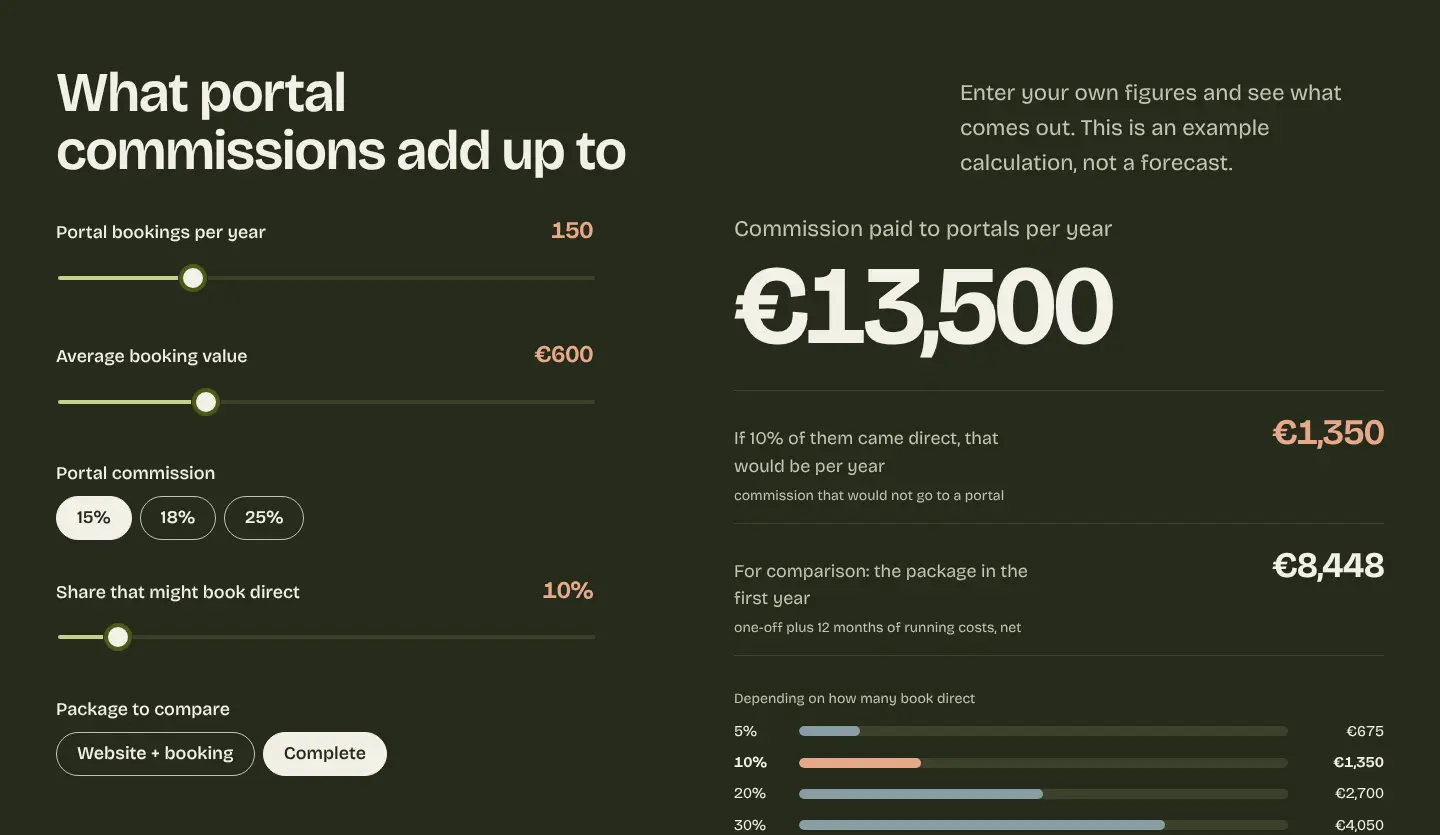
With your own numbers it is quicker in the commission calculator. There you set your bookings, booking value, commission and the share that could come direct.
Why the portals still have their place
I don't want to write against Booking.com here. For many guests the portal is the first place they ever hear about your property. And some of them then search for your name on Google and book direct.
- 1
Found on the portal
The guest sees your property on Booking.com. - 2
Searches your name
They google you to find out more. - 3
Lands on your site
Photos, prices and free dates at a glance. - 4
Books direct
No commission, as long as they can also book there.
There is a well-known study from Cornell University from 2009. Chris Anderson showed there that hotels listed on Expedia got an additional 7.5 to 26 percent more bookings through their own channels. It is called the billboard effect: the portal works like a billboard.
For that effect to reach you, though, there has to be somewhere to book directly. If someone searches for your name and only finds a page with a phone number and a contact form, they go back to the portal. The "Book now" button is already there.
Are you allowed to be cheaper direct?
Yes. In May 2024 the European Commission designated Booking.com as a gatekeeper under the Digital Markets Act. Since 14 November 2024 the portal may no longer forbid properties in the EU from offering different prices on other channels, including their own website. Prices on other channels also may no longer affect your participation in programmes such as Genius or Preferred. At the end of September 2026 the Commission published further commitments from Booking.com on this.
-
The European Commission designates Booking.com as a gatekeeper under the Digital Markets Act.
-
Booking.com may no longer forbid different prices on other channels, including your own website.
-
The Commission publishes further commitments from Booking.com, among other things on Genius and Preferred.
You don't necessarily have to lower the price. Often a small extra that costs you little is enough: a breakfast basket on the first morning, a later check-out, free cancellation until shortly before arrival. What matters is that the guest actually sees the benefit on your site.
What a direct booking needs
Before someone really presses "Book", a few small things have to fit together. These are the points that, in my experience, make the difference.
A calendar that is right
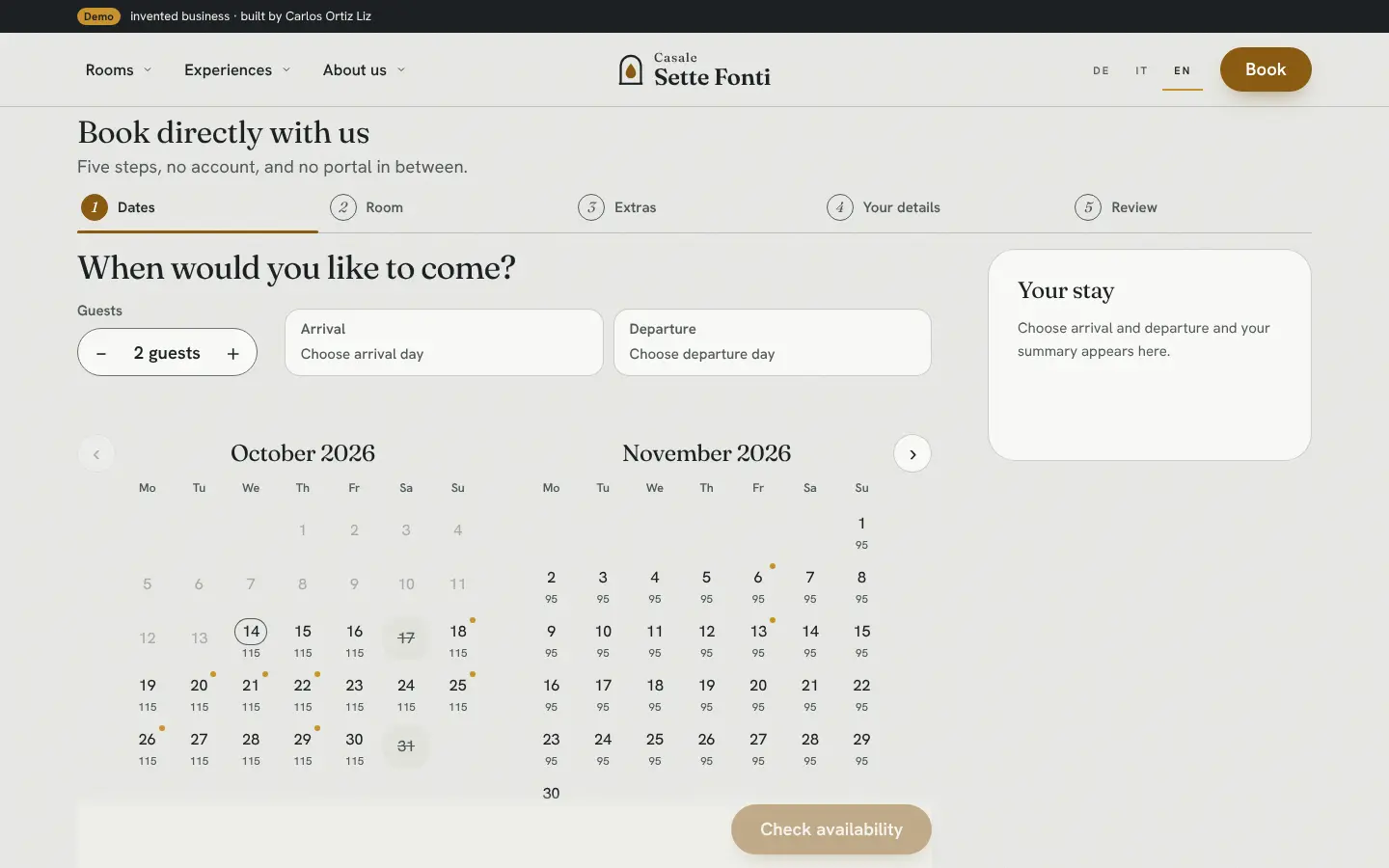
Guests want to see whether their dates are free and what it costs, without sending an enquiry and waiting for a reply. So the calendar on your site has to be synced with the portals, otherwise you risk double bookings. For a single apartment, syncing through iCal links is often enough. With several units a channel manager is worth it, one that passes prices and availability in every direction.
A page that loads fast on a phone
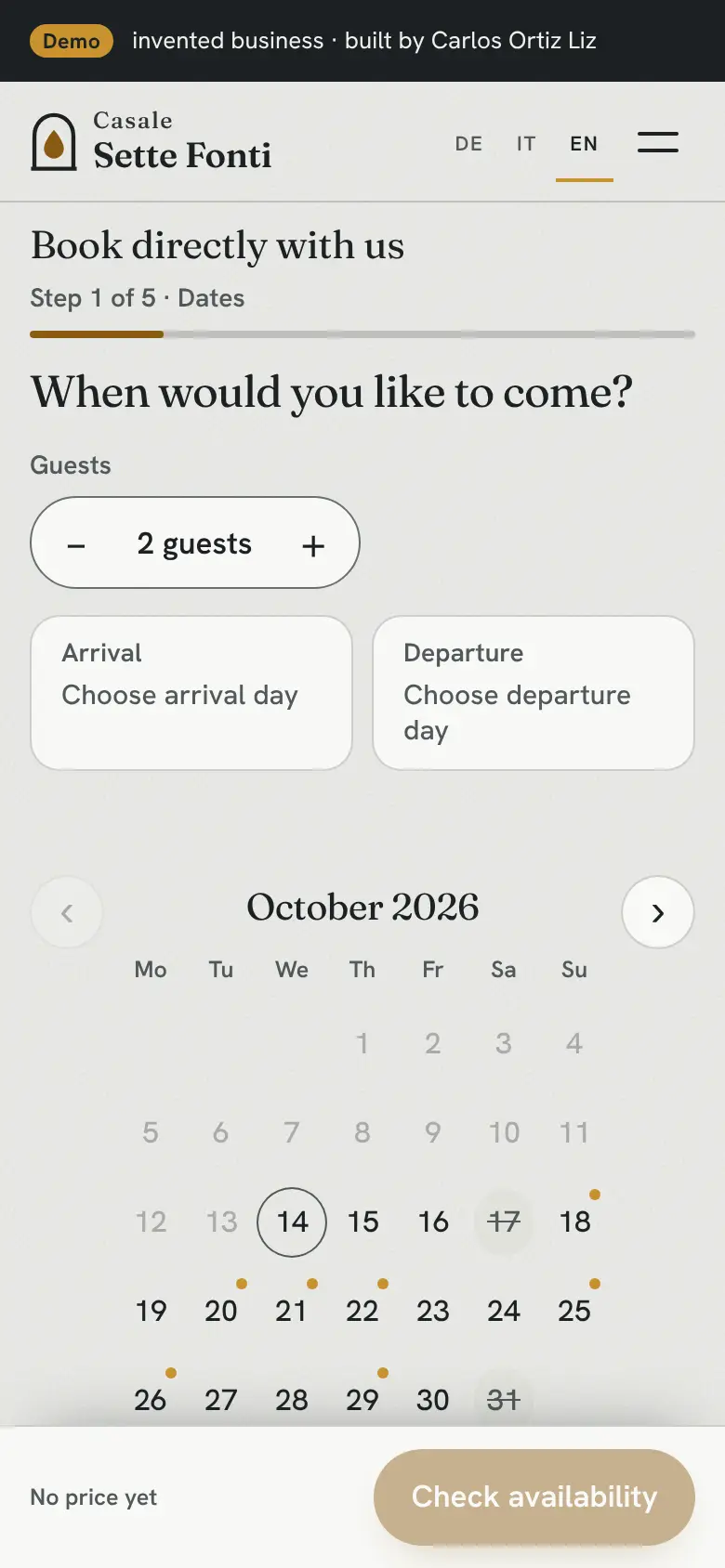
Many guests look at a property on their phone first. If the page takes a long time to load there, or the booking button only appears after scrolling three times, they are gone. Google measures how fast your page really is with PageSpeed Insights. In the website check you get these values together with an explanation.
Being found on Google
Someone who saw your name on Booking.com and then googles it should find your own site right at the top. That takes a well-kept Google Business Profile with photos and a link to your booking page, and a website that Google can read easily: clear titles, one description per page, language versions properly linked.
Knowing where bookings come from
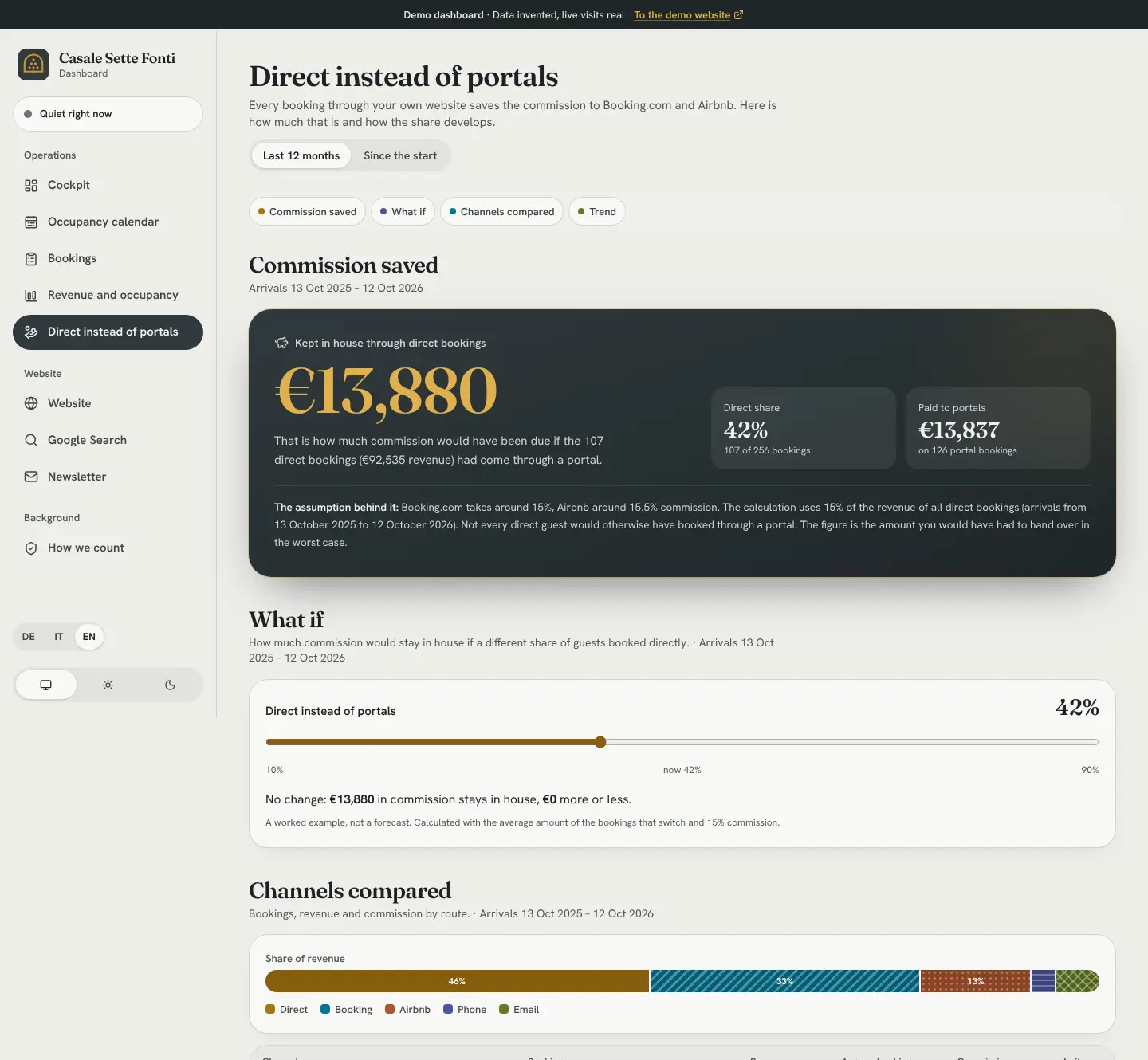
Without numbers, everything stays a gut feeling. You should be able to see how many bookings came direct, which route guests took to find your site and where they drop out. That works without Google Analytics and without a cookie banner, with a measurement of your own that stores no personal data.
Turning portal guests into regulars
The guest who has already stayed once is worth the most. Someone who leaves happy will gladly book direct next time, if they know how. A few things have worked well for this:
- A small card in the apartment with your website and the benefit for direct bookers.
- Your website in the welcome folder and on the Wi-Fi note, so right where guests look anyway.
- A newsletter that guests sign up to themselves, for example through a QR code in the apartment.
Lovely to have you
Book direct next time
If you book directly with us, you will find a breakfast basket in the kitchen when you arrive.
There is one thing you should leave alone: writing to guests from portal bookings without being asked, to advertise the next booking. The contact details from a booking are there to handle the stay. For advertising by email or message you generally need the guest's consent. The GDPR requires that, and in Germany so does the Act against Unfair Competition.
How much does this come to for you?
That depends on your numbers, and only you know them. If you like, work them out in the commission calculator. And if you want to know where your website stands today, do the free website check. After about a minute you have the measurements from Google and a calculation of the portal commission for your property.
If you have questions, just write to me. I reply myself, in English, German or Spanish.
Frequently asked questions
How high is the commission on Booking.com?
Booking.com charges a fixed percentage of the value of every reservation. The rate depends on the country, type and location of the property, and for holiday rentals it is usually 15 percent. Programmes such as Genius, Preferred Partner or the Visibility Booster raise it.
What do hosts pay on Airbnb?
With the split fee, the host pays around 3 percent and the guest pays the rest. Since 2025 Airbnb has been moving step by step to a fee that only the host pays. It is 15.5 percent, and in Italy it can be higher.
Can I be cheaper on my website than on Booking.com?
Yes. Since 14 November 2024, under the Digital Markets Act, Booking.com may no longer forbid properties in the EU from offering different prices on other channels, including their own website.
Is a booking system of my own worth it for a single holiday rental?
That depends on your revenue and the share of portal bookings. In the example with €18,000 in revenue, you keep €540 to €648 more per year if the share through the portal drops from 70 to 50 percent. The commission calculator lets you check that with your own numbers.
How do I avoid double bookings between my website and the portals?
The calendar on your own website has to be synced with the portals. For a single property, syncing through iCal links is often enough. For several units, use a channel manager.
Sources
- Booking.com Partner Hub: Understanding our commission
- Holidu: Provisionen der wichtigsten Portale für Ferienhäuser (Februar 2026)
- Hospitable: Airbnb service fees, split fee vs. host-only fee
- Hospitality ON: Brussels secures new guarantees from Booking.com on hoteliers’ pricing freedom (30.09.2026)
- Chris Anderson, Cornell University: The Billboard Effect (2009)
Information as of 13 October 2026. Portal fees change; if in doubt, your contract applies.