Analytics
Analytics without Google Analytics:what hosts really need to know about their website
Behind a cookie banner, Google Analytics often sees only a small share of your guests. Here is why, which four numbers really matter for a holiday business and how analytics works without cookies and, in most cases, without a banner.

Carlos Ortiz Liz
· 8 min read
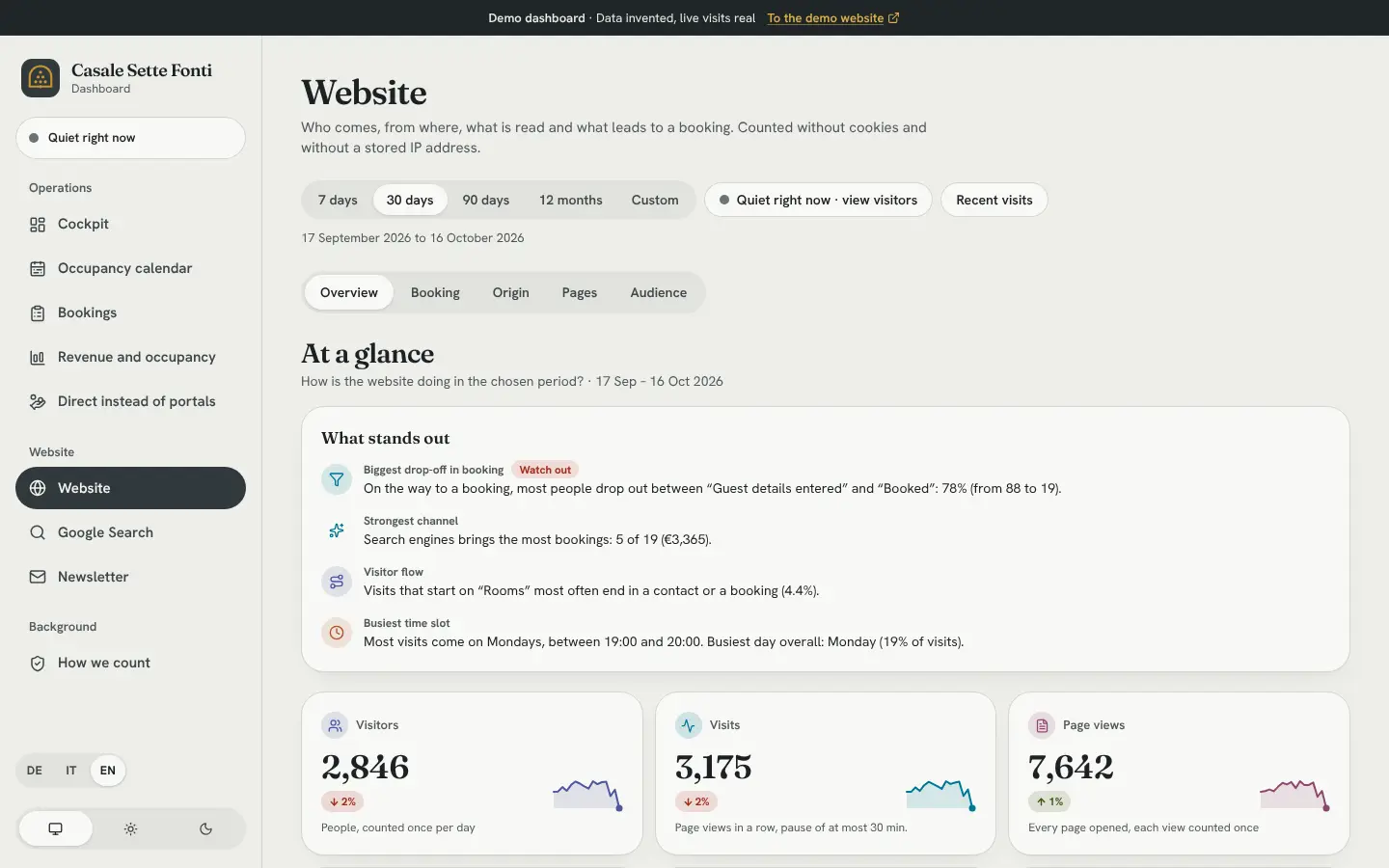
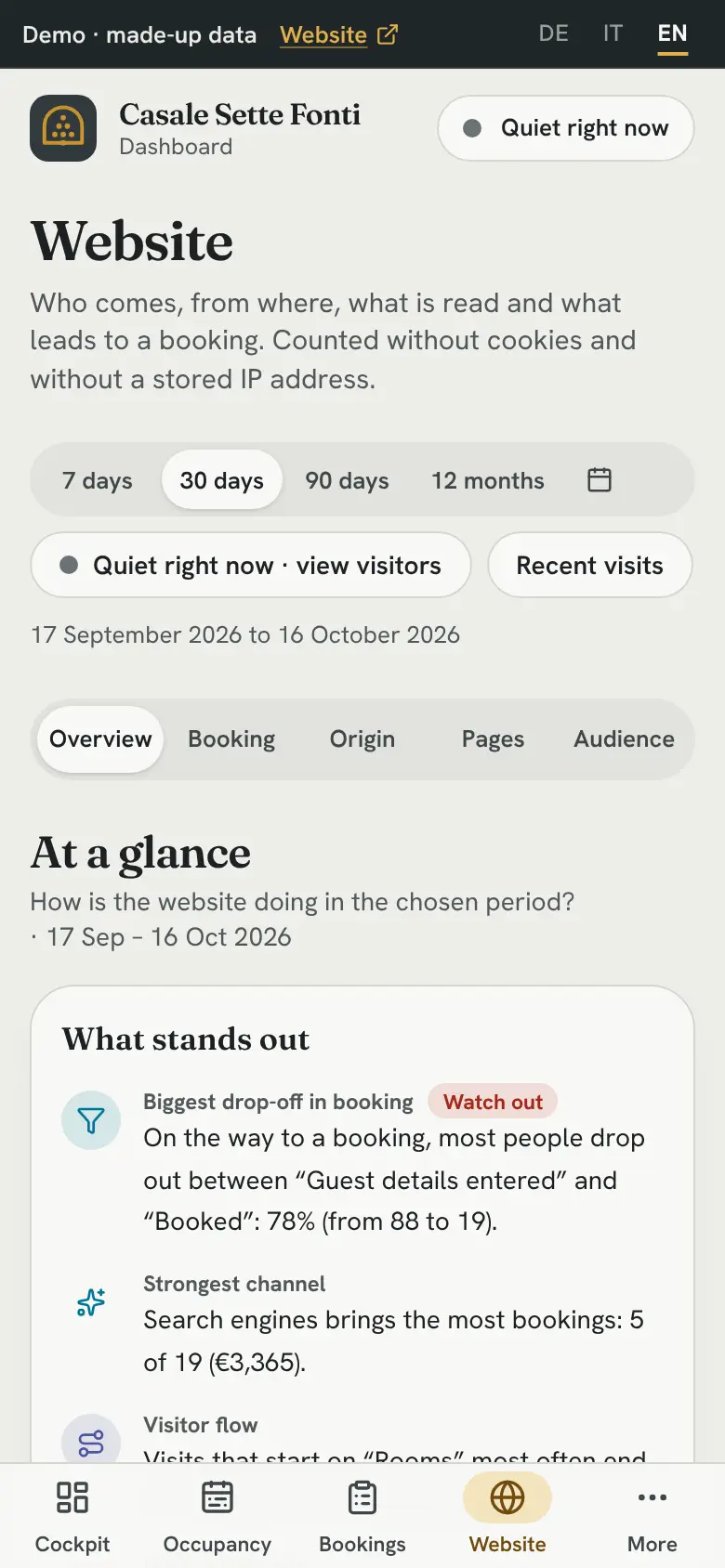
Alongside tourism, I have advised companies on marketing and analytics for years. I have set up a lot of Google Analytics accounts, and sooner or later the same question almost always comes up: why does Analytics show so many fewer visitors than were obviously there?
The answer usually sits at the bottom of the page, in the cookie banner. Anyone who declines there is invisible to Google Analytics. And that is more people than most expect.
Google Analytics with a fair banner
17 out of 100
That is the average share who agree when “Reject” sits next to “Accept” at the same size.
Analytics without cookies
100 out of 100
Every visit is counted, bots are filtered out first.
Consent rate from an etracker study of 275 German-language websites in the first half of 2022. Across all banners the average was 41%.
What the cookie banner swallows
Google Analytics stores cookies in your guests’ browsers and reads them back. In the EU you need the visitor’s consent for that, and the tool must not start before it. In Germany this is § 25 of the TDDDG, in Italy the cookie guidelines of the data protection authority, the Garante. Both go back to the same European rule.
How many people then agree was measured in 2022 by the analytics company etracker, across 275 German-language websites with around 500 million visits. Averaged over all banners, 41% agreed. With banners that make rejecting as easy as accepting, as data protection authorities require, it was only 17%. On phones consent was lower than on computers, 38% against 45%.
The problem is not just the smaller number. People who accept are not necessarily typical guests. Telling whether Instagram or Google brings more bookings from a fifth of your visits is hard, especially for a holiday rental with a few hundred visits a month.
Is Google Analytics even allowed?
With consent, yes. For a long time the argument was about something else: that the data goes to Google in the United States. In June 2022 the Italian Garante found that one Italian site’s use of Google Analytics broke the rules, because data such as the IP address went to the US without adequate protection. The operator was given 90 days to fix it.
-
The Garante rules against an Italian site’s use of Google Analytics because of data transfers to the US.
-
The European Commission adopts the EU-US Data Privacy Framework. Data can again go to certified US companies.
-
The EU General Court dismisses a challenge to the Data Privacy Framework.
-
An appeal against that ruling is lodged with the Court of Justice. The decision is still pending.
Today Google Analytics is allowed with consent and a suitable privacy policy. Some uncertainty remains until the Court of Justice has ruled. For a small business, though, that is a side issue. The more important question is the one above: what use are numbers that show only a small share of your guests?
Four numbers that are enough for a holiday business
Google Analytics has hundreds of reports. A host needs very few of them. When I talk to businesses about their website, we nearly always end up at the same four questions.
Visits, not page views
A guest who looks at rooms, prices and directions makes three page views but only one visit. The visit is what counts for you. If the number climbs in March, people are planning their summer. If May brings fewer visits than last year, that is a reason to look more closely.
Where visits come from
Google Search, Google Maps, Booking.com, Instagram, a newsletter, a travel blog that linked to you. It gets interesting once you see which route also leads to bookings and not just to visits. So that Instagram and newsletters are recognised properly, add small tags to your links, the UTM parameters, for example ?utm_source=instagram.
Where guests drop out on the way to booking
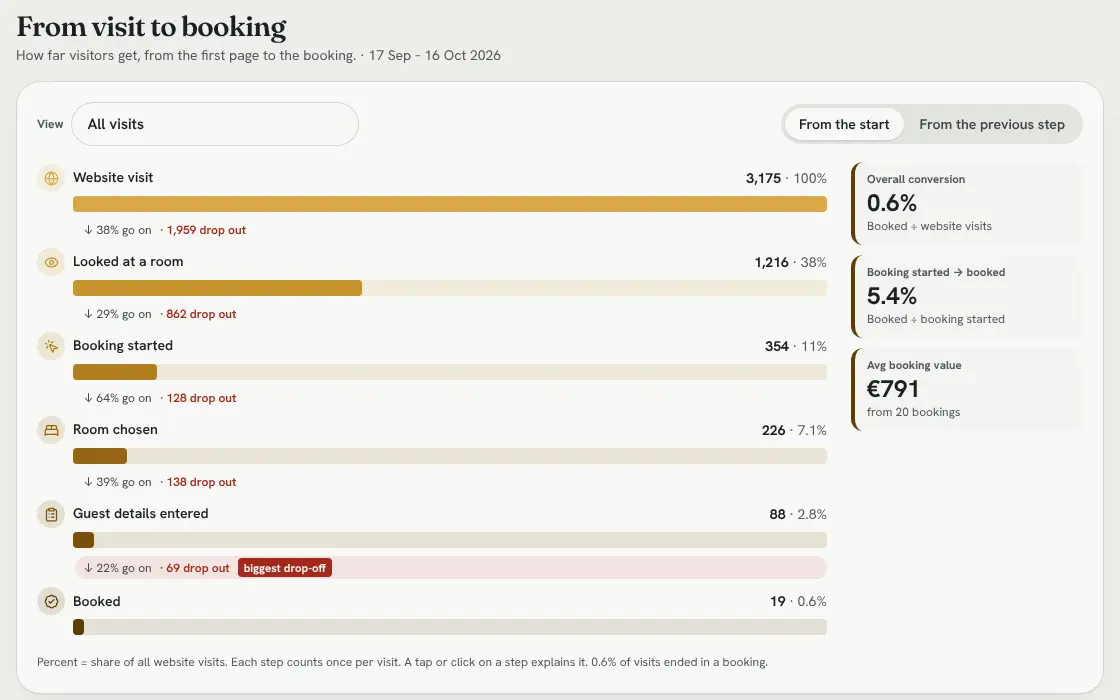
This is the number you can do the most with. From the home page to the rooms, to the calendar, to the guest details, to the confirmation: at every step some people get lost. If most stop at the guest details, there may be too many required fields. If they already stop at the calendar, maybe prices only appear there and come as a surprise.
How many book directly
In the end, what counts is how many bookings come without a portal and how that share changes over the months. This number does not come from your analytics but from your booking system. It becomes really useful when the two are connected: this booking came through Google, that one through the newsletter. What that means in commission is covered in the article on Booking.com commission.
How analytics without cookies works
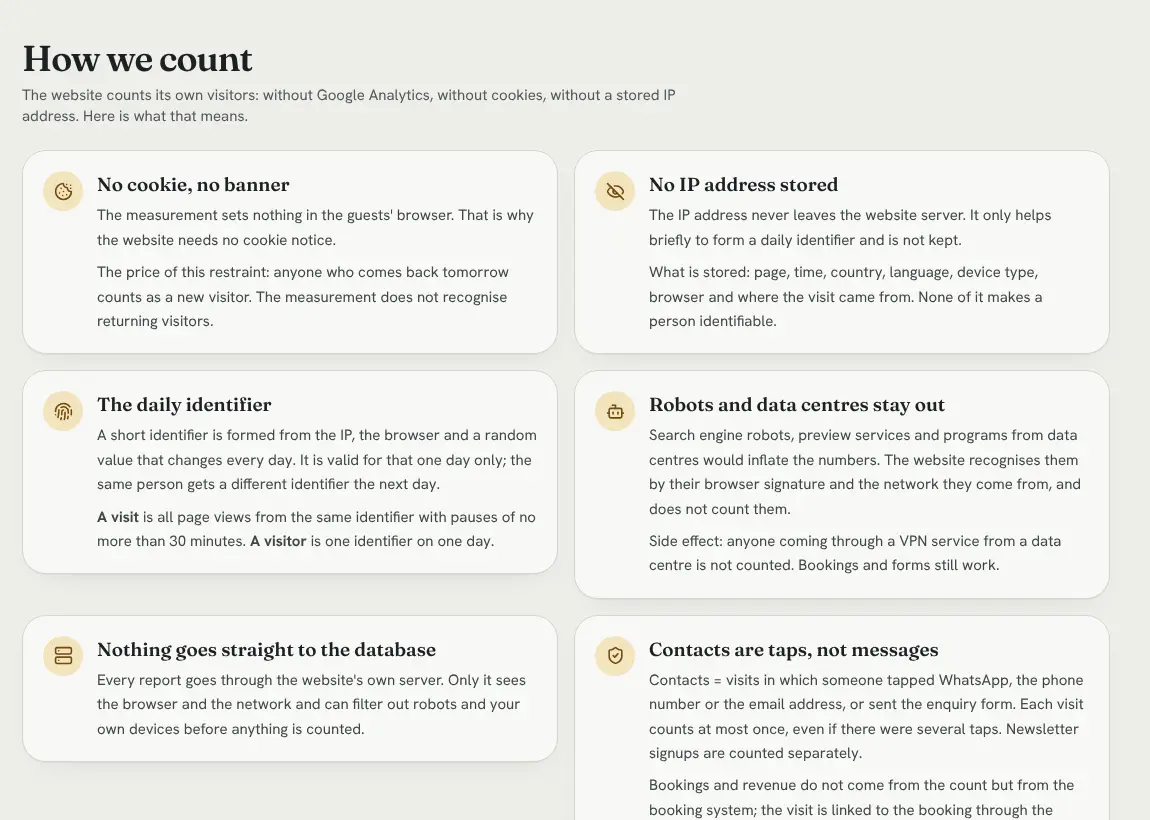
Analytics without cookies stores nothing in your guests’ browsers. Counting happens on the website’s server, where the page is delivered anyway. This is how we do it in the websites I build:
- 1
A page is opened
As with any website, the browser sends the address and browser type. - 2
Daily code
IP, browser and a random value for the day become an unreadable code. - 3
IP is discarded
What is stored: page, time, country, device type and source. - 4
Counted
Page views with at most 30 minutes in between make one visit.
Because the random value changes every day, the same person gets a new code the next day. That is the price: someone who returns a week later is not recognised, and the data is no use for ads that follow visitors around Instagram later. For a holiday business that is usually a good trade.
Google Analytics with banner
17 to 41%
of visits visible, depending on the banner
- Needs consent and a cookie banner
- Data sits with Google
- Recognises returning visitors and can steer ads
Your own analytics without cookies
every visit
without bots and data centres
- No cookie, usually no banner needed for it
- Data sits in your own database
- Knows the path all the way to the booking
Consent rates from the etracker study (2022). Whether you need a banner at all also depends on what else your site loads.
The legal details differ between EU countries but end up in a similar place. In Germany, § 25 TDDDG requires consent for accessing the visitor’s device, which means setting or reading cookies. Data the browser sends with every request anyway is widely seen as falling outside that, as long as it only feeds your own statistics and is not combined with other providers’ data. In Italy, the Garante treats analytics cookies like technical cookies, which need no consent, if they produce only aggregate figures, the IP address is shortened and the data is not linked to anything else.
Ready-made alternatives to Google Analytics
You do not have to write any code for this. There are ready-made analytics tools without cookies. Plausible counts much like the method above, with a code that can no longer be traced after 24 hours, and keeps the data in the EU. Matomo can run on your own server and, with one checkbox, work entirely without cookies. Both count visits, pages and sources reliably.
What they lack is the link to your bookings. They know someone clicked “Book”, but not whether that turned into an €800 booking or a drop-out at the calendar. That is exactly why I build website, booking and analytics together: every booking is matched to its visit, and the dashboard shows which route pays off.
You can try it yourself in the demos. Make a test booking on the website of the made-up agriturismo and then look at it in the dashboard. The data there is made up, your own visits are real.
What you can do today
Even if you stay with Google Analytics, you can do quite a bit better:
- Read your numbers as a sample. If only one in three agrees, 300 visitors in Analytics may stand for 900 real ones.
- Check that your tracking really starts only after consent. If it loads before, you have a data protection problem.
- Add UTM parameters to the links on Instagram, in your newsletter and in your Google Business Profile, so you can tell the routes apart.
- With every direct booking, ask how the guest found you. A simple choice field in the booking form is enough.
- Set up Google Search Console. It shows which searches your site appears for and sets no cookies on your visitors.
To see what a dashboard without cookies looks like for a host, open the demo dashboard. If you have questions, just write to me. I reply myself, in English, German or Spanish.
Frequently asked questions
Do I still need a cookie banner without Google Analytics?
Only if your site loads other services that need consent, for example embedded maps, videos or fonts from other servers. Analytics without cookies usually needs no banner. If in doubt, ask a data protection specialist.
Is Google Analytics allowed in the EU?
Yes, with visitors’ consent and a suitable privacy policy. The EU-US Data Privacy Framework has applied since July 2023, and the EU General Court upheld it in September 2025. An appeal to the Court of Justice is still open.
How many visitors does Google Analytics see behind a cookie banner?
In an etracker study of 275 German-language websites, 41% agreed on average, and only 17% with banners that offer an equal reject button. The remaining visits are missing from the statistics.
What is analytics without cookies?
Statistics that store nothing in the browser. The website’s server counts page views and creates a short code for this that is valid for one day only. The IP address is not stored.
What does analytics without cookies not know?
Whether someone comes back after a few days. It is also not suitable for showing visitors ads later. Visits, sources, pages read and the path to booking are shown in full.
Sources
- etracker: Consent Study 2022 (275 websites, first half of 2022)
- Google Analytics Help: Behavioral modeling for consent mode
- Garante privacy: Linee guida cookie e altri strumenti di tracciamento (10.06.2021)
- Il Post: Al Garante della privacy non piace Google Analytics (25.06.2022)
- Hunton: EU General Court confirms adequacy of EU-U.S. Data Privacy Framework (09.2025)
- WilmerHale: European Court of Justice to review challenge to EU-U.S. Data Privacy Framework (01.12.2025)
- Dr. Datenschutz: Webanalyse und Nutzerstatistiken ohne Einwilligung (German)
- Plausible: Data policy
- Matomo: How do I enforce tracking without cookies?
Information as of 16 October 2026. This is not legal advice. Laws, rulings and Google’s terms change; for your site, ask someone who specialises in data protection.